Past Adventures
Part 1: A Three Month Adventure in North Western Ontario


Monday, 3 September 2012

So much time but so little to do...Wait, Scratch That, Reverse It!

Whew! What a long, exhausting, but exhilarating week! Soooo much has happened. Let's start at the beginning:

Hurricane Isaac 
Friday August 24 to Sunday August 26th

Well, while Tropical Storm (later Hurricane) Isaac was felt significantly in Haiti and the Dominican Republic, we here on the Island of Eleuthera felt the tail-end effect. We experienced periods of intense/sudden thunder/lightning storms, rain, and the most unbelievable winds! I believe at some point winds reached 40 knots or Gale force winds. I think the craziest part were people going out wind surfing (see pic below)! Not going to lie, I enjoyed having the tropical storm pass us as it alleviated the bugs (mosquitoes and no-see-ums) for a few days. Just enough time for my arms and legs to heal enough so that when the bugs came back they would have more to feast on lol.

The pictures below were taken right before the sky opened up and unleashed it's fury!


Wet Lab Experiments
Monday August 27 and Wednesday August 29

 Last week I got to take part in some very interesting ongoing physiological experiments on 4 different Caribbean fish species: Bonefish, Puffer Fish, Schoolmaster Snapper, and Mojarra. Physiology, in layman's terms, is the study into how organisms function. With increasing concern regarding "climate change" and "global warming", scientists are interested to see how changing pH and temperature could affect various marine species. We were conducting these physiolocial tests to determine how species, such as the bonefish, function in changing environmental conditions such as decreasing pH, and increasing/decreasing temperature. We wanted to determine at which temperature or pH is too much for the species to handle, and therefore cause them to loose equilibrium (roll onto their back). This is called their critical temperature maximums, critical temperature minimums, and critical pH.

I had the opportunity to help set up the system used in the experiment which was challenging but very interesting! Using a combination of PVC tubes, water pumps, hoses, totes, and coolers, we constructed this "raceway" where we can contain the fish and control a particular environmental condition by continuously circulating the same water through the system. Airstones, which are porous stones that are connected to an air supply that diffuse air into the water, were added to help maintain the dissolved oxygen for the fish. The totes, in which the fish were placed, have 6 holes placed a couple inches from the top of the case to allow old water to filter out as new water is continually being added to each holding container. These experiments lasted only an hour or so and is very interesting to see how different species react to different environmental conditions.


After the tests were concluded, fish were moved to recovery tanks where they remained for a few days and then they were released back into the ocean.

The bonefish (see below) are part of an ongoing collaborative, and volunteer tagging program in order to assess their growth and movement patterns throughout the Bahamas. Bonefish, once well recovered from the tests, were tagged and released. Two were released into the artificial (planted) mangrove, and the rest released back in the ocean. The artificial mangrove that we have on campus had one lone bonefish for the longest time! Once we saw him fraternizing with the Cuda (barracuda) we decided it was time to give him some friends to hang out with. Within seconds of the two tagged bonefish (I named them Bonnie and Clyde) being released into the mangroves, the lone bonefish swam straight over! I think he was finally happy to have a group to swim with. They have been inseparable ever since!


Field Work
Tuesday August 28, Thursday August 30, Friday August 31

I also had an opportunity to get out into the field to try and catch some more bonefish, mojarra and snapper. On Tuesday the Flats team went out with the Sharks team for a joint seining attempt. This involved going out at high tide to one of the flats (can't remember which one at the moment), setting up the seine net at the flat entrance, and sitting in the water for 3 hours to wait for the tide to go down (Let me tell you, that is the life).

We caught two sea turtles, quite a few juvenile lemon sharks, but no bonefish....again. On Thursday we went out to try and catch some desperately needed bonefish (down to 9 in the wet lab). We caught some mojarra, a 4 ft nurse shark, but once again no bonefish. I saw a school of 15 lemon sharks...no bonefish. Possible tiger shark bit a hole in our net, but NO BONEFISH! I am starting to think that i am cursed! Every time the team takes me into the field, we never catch bonefish! So when we went out on Friday, I was determined to redeem myself! We went to a flat called Page Creek in order to restock on schoolmaster snapper. We used a technique called handlining, which involves dangling a piece of fishing line with a sardine baited hook into the mangroves and hoping for a bite, and of the 15 snappers we brought back to the lab, I caught 7 of them!!! I think I found my calling :D


Not only was it a greater fishing day, but it was also a beautiful location, and I finally got to use my underwater camera. Below are some of the photos taken on my camera by myself and another Intern who joined us that day.


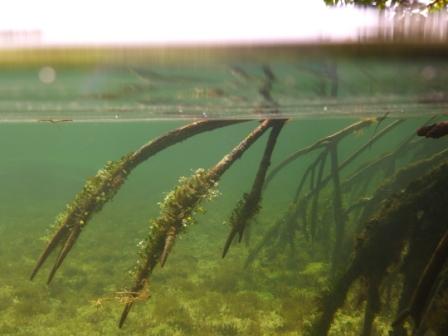


Finally, I would also like to report that I did my required check-out dive this last weekend, which means that I should be able to share with you some of my diving adventures and photos along the way!

Until next time!

Sincerely,

Your Master-Snapper-Catcher Field Biologist


Thursday, 23 August 2012

Simon Says...Do this for the rest of your life

I cannot believe this is my life for the next four months! I am having an amazing time and meeting such amazing people!

Today I went out on Surface Support for a couple of grad students from Oregon State University who are on campus studying the Lionfish on the patch reefs. Basically Surface Support means I stay on the boat (the "Simon Says") while the students conduct their dives. I am responsible for maintaining radio contact with CEI should anything happen to the divers. If CEI radios "Simon Says, Simon Says, go to 14" I must be available to respond. Every dive boat that goes out must have surface support.

Below is a picture of the Simon Says, on which i spent my day:

We left at 9:15am and returned to campus at 4:30pm. It was surprisingly the most relaxing day! I listened to some music (mixture of 80s rock and classic Caribbean vacation music), read a book, and just enjoyed being out in the middle of the ocean. Despite the choppy waves, it was so peaceful and I would do it again in an instant!

I also had a brief opportunity to snorkel around the boat and test out the underwater casing for my camera for the first time. I took the following picture of the two grad students heading out on their second dive of the day. You can kind of see the patch reef below them that is around 50 - 60 ft from the surface.


Until next time!

Sincerely,

Your slightly-sunburnt-but-unbelievably-relaxed Field Biologist

Let's talk fish just for the halibut

So far so good! I have made it through Orientation and now on to the fun stuff! I am in my second week and I have had the opportunity to work in the Wet Lab and go out in the field. 

The Wet Lab (see below) is a space shared by the Aquaponics, Aquaculture, and Flats Teams. This space is a 5000 square foot solar powered wet lab and is responsible for brood stock husbandry, rotifer and artemia culture, larval rearing, fingerling grow out, and laboratory research studies on various fish species. Mainly my chores here have included taking morning tank conditions, and helping to reorganize and clean the lab. I am still getting acclimated to what I will be working on in this lab so I will keep you all posted!


I went out in the field for the first time yesterday. We went to a flat called broad creek hoping to catch and tag bonefish. I think the best part of the day was creating a "scare-line". The general idea was to line everyone out across the flat/inlet and walk forward together splashing and make as much sound as we could to try and move the school to the back corner in order to corral and capture them using a seine net. No bonefish caught, BUT I did see 5 juvenile lemon sharks, and 4 houndfish!

For those of you that don't know, here is what a bonefish looks like:
Bonefish are an ecologically and commercially important species in the Bahamas. The adult bonefish spend the majority of their time benthic foraging which helps shape the flats' substrate. However more research is needed to understand these important species. Flats researchers at the Cape Eleuthera Institute (where I am staying and working) as well as visiting researchers are collectively gathering information on bonefish. Such studies include (http://www.ceibahamas.org/bonefish.aspx):
  • Quantifying the effects of catch-and-release angling on bonefish
  • Determining the attributes of the angling event that affect the susceptibility of bonefish to mortality post-release
  • Quantifying the movements and interactions between bonefish and their predators
  • Determining how predators cue in on bonefish following catch-and-release angling
  • Examining the physiological response of bonefish to angling
  • Assessing whether catch-and-release angling is compatible with fisheries management strategies, including marine protected areas
  • Determining the effects of habitat disturbance on the population ecology of bonefish
  • Determining where and when bonefish spawn
  • Determining the effects of global climate change on the metabolic rates of bonefish
  • Tracking the movements and growth rates of bonefish
I am so excited to work on the many projects open to me over the next 4 months!

Until next time!

Sincerely,

Your fish corralling - equipment de-algalfying - fish punning Field Biologist

Sunday, 19 August 2012

Set Your Watch to Bahamian Time!

Hello Everyone. Greetings from the Bahamas! I am back to bring you more stories of my field experiences, this time from the Caribbean

I am currently on the Island of Eleuthera which is approximately 80 km East of Nassau, and only an hour (by plane of course) from Florida. The Island is 180 km long and is as little as 1.6 km wide in places.

Eleuthera is derived from the Greek word eleuthros which means "Free". While I have only been here for five days, I think this is an amazing description of this astonishing place i am staying at. The people are warm, kind, and welcoming, and the views are absolutely breathtaking! For example, the following pics are of the view from the porch of my dorm!


For the next four months I will be working as an Intern conducting research in the coastal zones, also known as the "Flats". Right now we (Interns) are just getting oriented so I will return terreckly (which is a Bahamian saying for soon) with more updates on my work and this marvelous adventure I've undertaken!

Sincerely,

Your crazily-excited-can't-believe-I'm-here Field Biologist

Tuesday, 23 August 2011

Time to Ramble on

Well my summer work is coming to an end and even though I am suffering through horrible internet connections, I would like to give you one last summer post!

To celebrate the summer coming to an end, I made the cake in the picture below in honour of our work this summer:
It is a Brook Trout, one of the species of fish found on our rivers this summer! The picture below is of a small brook trout we caught electrofishing
Leaves are fallin' all around, time I was on my way
Thanks to you, I'm much obliged for such a pleasant stay
but now it's time for me to go, the autumn moon lights my way
for now I smell the rain, and with it, pain
and it's headed my way
Aw, sometimes I grow so tired
but I know I've got one thing I got to do
A-ramble on...

~Ramble On, Led Zeppelin


 There are places I'll remember
All my life though some have changed
Some forever not for better
Some have gone and some remain
All these places had their moments
With lovers and friends I still can recall
Some are dead and some are living
In my life I've loved them all
~ In My Life, The Beatles


This has been an absolutely amazing experience! I will never forget all the wonderful people I have met, skills i've learned, and places i've seen. I am walking away from this summer not only with more knowledge of the aquatic ecosystem, but more physically fit/healthy, and I am really in touch with who I am and what I want out of life. I am in my final year of University, with so many opportunities now open to me. It is the time to take action, follow my dreams, and see where life takes me.
So this is not goodbye, more like talk to soon...who knows when my next field adventure will take place :D

Goodbye for now,

your Field Biologist
xoxo

Wednesday, 3 August 2011

There's no place like (a summer) Home

So it just occurred to me that I have yet to post any photos of my home in Searchmont this summer!
We are staying at the Searchmont Ski Resort. I would talk about the amazing-ness of this place, but I think I will just let the pictures speak for themselves :D


My Cabin!!

View from my window. Lovely way to wake up!


Having fun on a chairlift

Two of the Techs built this Lean-to so they could sleep outside...good plan in theory, but the black flies, and horse flies, and deer flies, and mosquitoes would drive me back inside after only a couple hours


View from the Mountain! Looking down on the Ski Resort. Isn't it Beautiful!


Sincerely,

your built-in-photographer Field Biologist